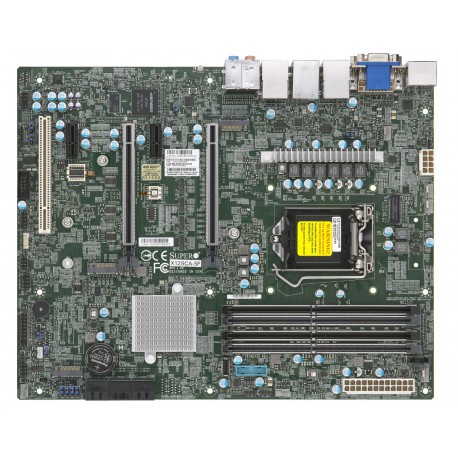
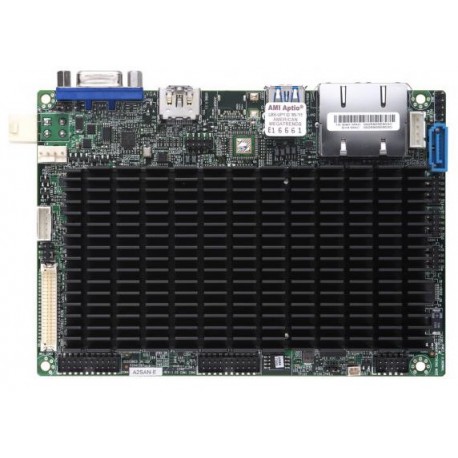
The Supermicro MBD-M11SDV-8C+-LN4F is a compact Mini-ITX server motherboard engineered for dense, power-efficient compute nodes, edge appliances and network-centric systems. It integrates an AMD EPYC Embedded 3251 SoC, combining multi-core performance with low thermal design power for continuous 24/7 operation.
Integrated processor and memory subsystem
Onboard AMD EPYC Embedded 3251 with 8 cores / 16 threads, base clock 2.5 GHz, 16 MB cache, 55W TDP for balanced performance and energy efficiency.
Single CPU socket design with the processor factory-installed, simplifying platform integration and reducing compatibility concerns.
4x DIMM slots supporting up to 512 GB Registered ECC DDR4-2666 SDRAM, enabling high memory density in a Mini-ITX footprint.
ECC (Error-Correcting Code) memory support increases data integrity, which is critical for virtualized, storage and network workloads.
Expansion and storage options
1x PCI Express 3.0 x16 slot for additional controllers, specialized network adapters or accelerator cards, allowing flexible system customization.
1x M.2 NVMe slot for high-speed SSDs, suitable for OS, cache or latency-sensitive applications.
Network and connectivity
4x RJ-45 1Gb/s Ethernet ports for multi-homed configurations, link aggregation, network segmentation or redundant connectivity.
2x USB 3.0 ports for high-bandwidth peripherals and external storage.
6x USB 2.0 ports for keyboard, mouse, management tools and legacy devices.
Form factor and deployment
Mini-ITX form factor enables deployment in compact chassis and space-constrained environments such as edge, telecom or embedded server platforms.
The integrated CPU reduces mechanical complexity and simplifies thermal design compared to traditional socketed solutions.
The combination of ECC memory support and server-class design helps maintain system stability under continuous load.
This platform is suitable for applications that require a compact yet capable server-grade motherboard with robust networking, high memory capacity and efficient power usage, such as virtualization nodes, network appliances, security gateways and edge computing systems.








![[NR]X12SAE, Intel W480 Chipset, support Intel Comet lake-S](https://presta8.bizserver.eu/7109-large_default/supermicro-mbd-x12sae-motherboard.jpg "[NR]X12SAE, Intel W480 Chipset, support Intel Comet lake-S")